Hearst Castle
One hundred sixty-five rooms on a California hilltop, built for twenty-eight years and never finished.
Also known as La Cuesta Encantada — "The Enchanted Hill." Hearst himself mostly called it the ranch.
A little something
In 1919, at fifty-six, William Randolph Hearst inherited a quarter-million-acre cattle ranch on the Central California coast from his mother, Phoebe Apperson Hearst. He had camped on its highest hill as a boy, in tents grand enough to have names. That spring he walked into the San Francisco office of architect Julia Morgan and told her the family was tired of camping — he wanted to build "a little something."
The little something took twenty-eight years, and when construction finally stopped in 1947 it still was not done. It never would have been. Building it was the point.
The buildings
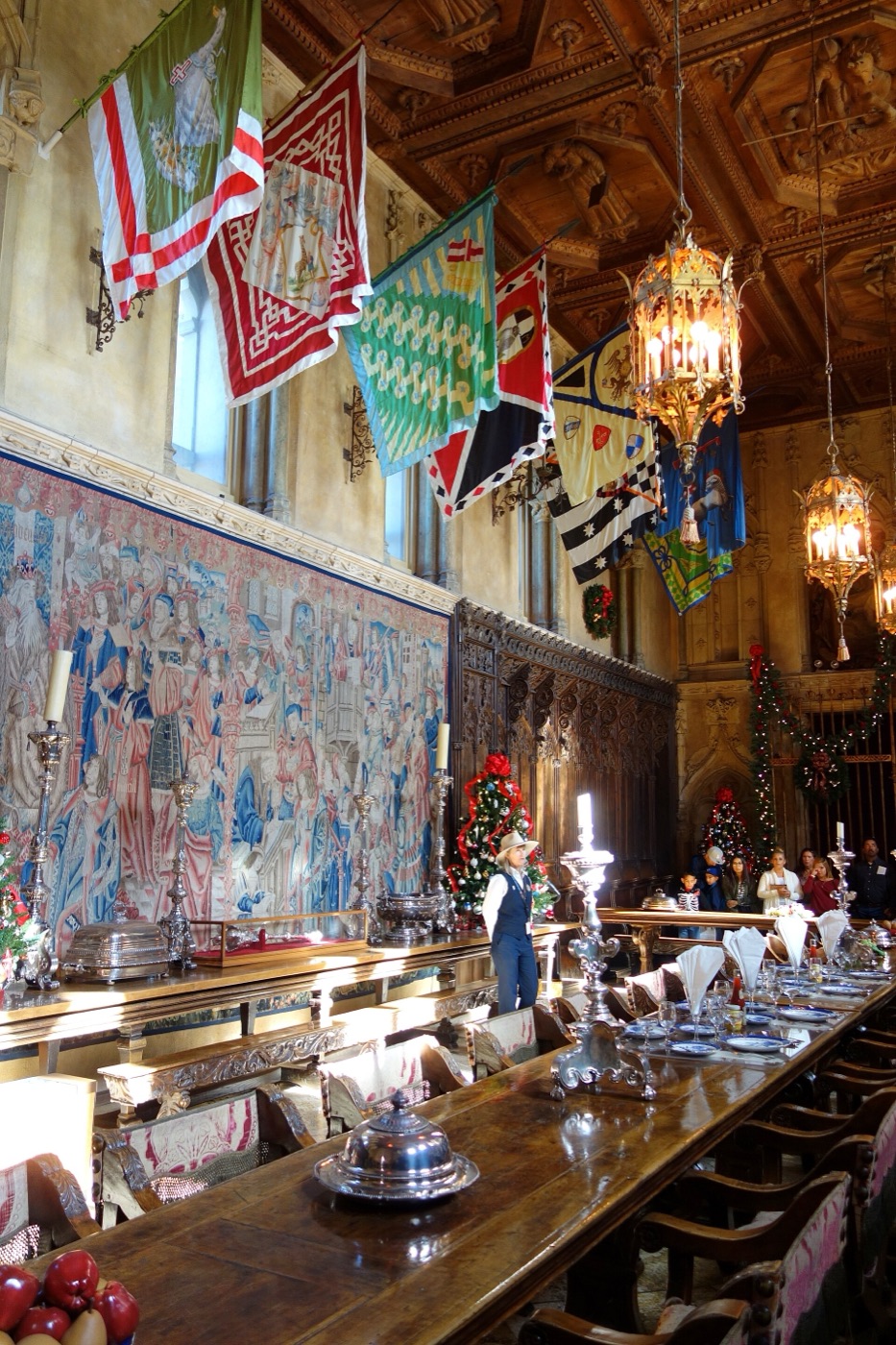
The hilltop holds a main house and three guest cottages. Casa Grande, the big house, raises twin bell towers modeled on a Spanish cathedral above 60,000 square feet of rooms: a Refectory hung with Flemish tapestries and choir stalls, an Assembly Room the size of a small church, a private movie theater, libraries, vaults. The cottages — Casa del Mar, Casa del Monte, Casa del Sol — are named for what they face: the sea, the mountains, the sun.
Almost everything inside came from somewhere else. Hearst bought carved ceilings from Italian palazzos, Greek vases, Egyptian statuary, whole rooms of Europe, and had them shipped through the warehouses at San Simeon Bay and trucked up the hill. The house was less designed around the collection than assembled from it — Morgan’s quiet genius was making it feel inevitable.
The pools
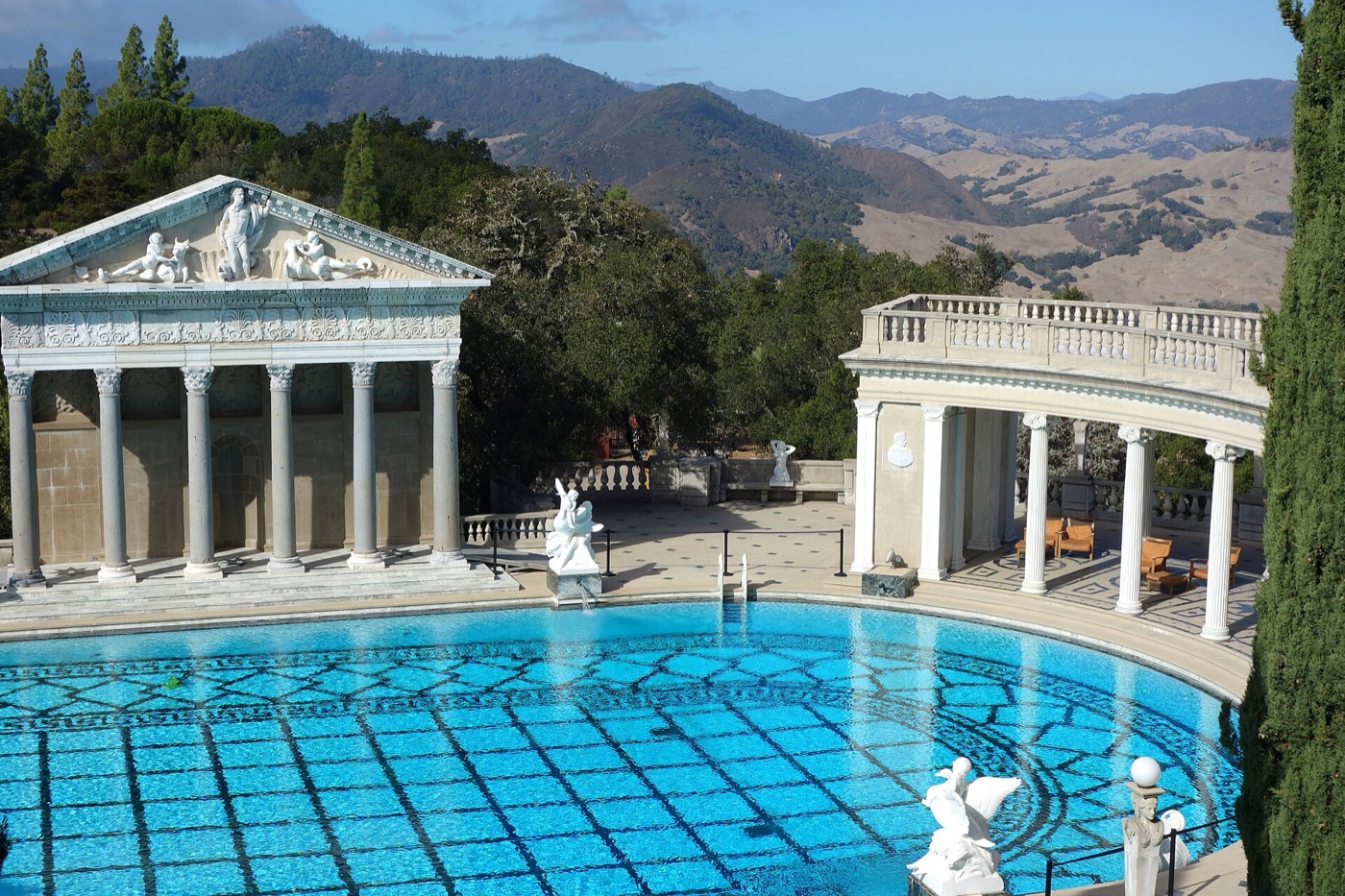
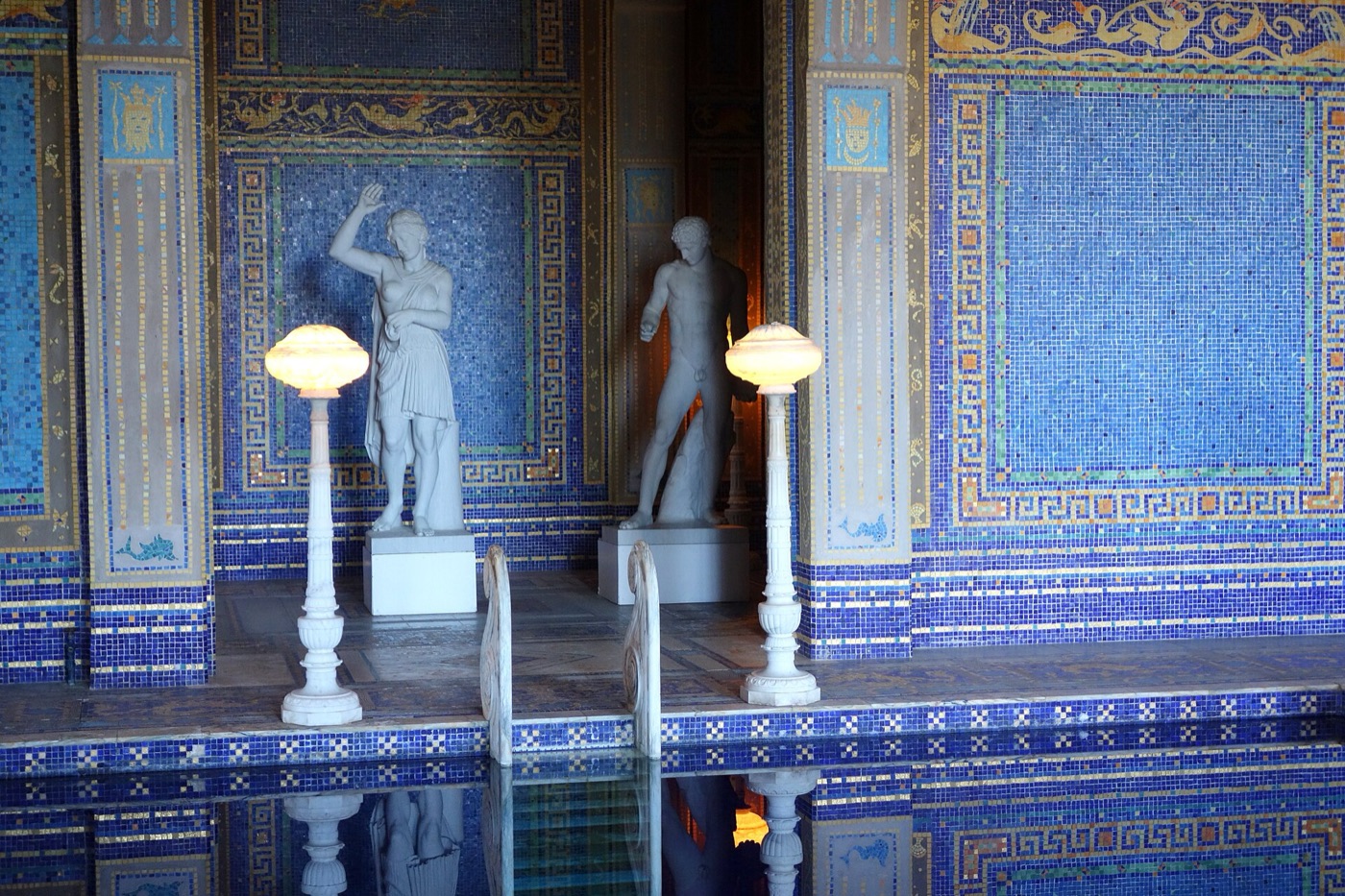
The two pools are the estate’s best-known rooms, and neither is indoors-ordinary. The Neptune Pool, outdoors, holds 345,000 gallons in a white marble colonnade wrapped around the facade of an ancient Roman temple; Hearst had Morgan rebuild it three times before it was grand enough. The Roman Pool, indoors, is a dim blue chamber tiled floor to ceiling in glass and hammered gold, styled after Roman baths.
Life up the hill
Through the 1920s and 30s the hilltop ran as the most exclusive hotel in America. Guests — Chaplin, Churchill, Garbo, Shaw, half of Hollywood — took the overnight train or landed at the private airfield, were assigned a cottage, and were free all day: tennis, horses, the zoo, the pools. Attendance was required only at dinner in the Refectory and at the nightly movie afterward. Marion Davies ran the fun; Hearst ran the schedule.
After
Hearst left the hill for the last time in 1947, too ill for its remoteness, and died in Beverly Hills in 1951. In 1957 the Hearst Corporation donated the estate to the State of California, and tours began the next year. Around three-quarters of a million people now ride the bus up the Enchanted Hill annually — past grazing zebras — to see a house that was never finished and no longer needs to be.
Its strangest afterlife, though, is on film: the castle is the acknowledged model for Xanadu, the mountaintop tomb-palace of Citizen Kane — a portrait so dark its owner spent years trying to kill the picture. See Xanadu.